


Havana’s energy ministry said earlier today that Cuba is experiencing another nation wide blackout, reported numerous news media outlets. It is its fifth national black out in less than a year, reported The Guardian. The cause of this humanitarian disaster remains the same. University of Pennsylvania Associate Professor Amalia Daché on October 21, 2024 on MSNBC, then in the midst of another nationwide outage in the island, explained it with both accuracy and brevity that eludes many, but remains relevant today.
“This is symptomatic of a larger system that the Cuban regime functions within, and the lack of investment into the power grid, into its electrical system has a lot to do with the fact that they mismanage their economy. They do not invest in the electrical system the way they should, such as modern societies, and the Cuban regime has just been, again, doing in appropriate things with the finances that they get from their allies, and they have not been appropriately funding the electrical grid in Cuba.”
Nora Gamez Torres provided needed background information and context in her reporting that appeared today in the Miami Herald in the article, “Another island-wide blackout in Cuba, as power grid collapses amid energy crisis“.
“The Cuban government has blamed the energy crisis on U.S. sanctions, pointing to sanctions on vessels transporting oil from Venezuela to Cuba and the general effect of the U.S. embargo in denying financial resources to the government. The U.S. sanctions, however, appear to have done little to deter the shipments from Venezuela, which continued, though at a lower pace because of Venezuela’s own production problems and decisions to prioritize dollar sales.
A recent Miami Herald investigation revealed that the Cuban military-run conglomerate GAESA held massive dollar reserves last year that could have been used to update the country’s old energy infrastructure.
Lately, the left-leaning Morena government in Mexico has stepped in to send oil to Cuba. Mexican state oil company Pemex sent one billion dollars in subsidized oil to Cuba between July 2023 and September 2024, according to an investigation by a Mexican civil society organization focused on exposing corruption. It sent another $850 million between May and June this year, the report says.”
This is in stark contrast to lazy reporting from NBC News, The Washington Post, and The Guardian which repeat regime talking points without any push back. While NBC News quotes Havana’s claims about the U.S. Embargo. The Washington Post and The Guardian go further claiming that the black outs are due to a lack of foreign currency reserves, ignoring the reporting that the Cuban military’s conglomerate GAESA is holding $18 billion in foreign reserves. Other countries with that amount of currency reserves are Panama, Costa Rica, and Uruguay. They do not have the nationwide power outages Cuba is suffering from.
Jorge Piñon, a Cuban-born energy expert at the University of Texas at Austin, highlighted that Cuba’s electricity grid relies on eight very large power plants that are close to 50 years old. “They have not received any operational maintenance, much less capital maintenance, in the last 12 to 15 years,” he said, adding that they have a lifetime of only 25 to 30 years. “So, No. 1, it’s a structural problem; they are breaking down all the time, and that has a domino effect,” he said.
Nora Gámez Torres of the Miami Herald cited Jorge Piñón, in her October 17, 2022 article “Cuba ramps up imports of Russian oil, helping Putin to evade sanctions” describing him as “a senior research fellow at the University of Texas at Austin’s Energy Center who closely tracks oil shipments to the island” in which the following revelation was made.
Amid economic and political turmoil, Cuba has received at least $322 million worth of oil from Russia since the start of the war in Ukraine as authorities struggle to offset diminished shipments from close ally Venezuela, according to estimates by oil industry experts. The 4 million barrels of Urals crude oil received by Cuba “is the largest quantity since the collapse of the Soviet Union,” said Jorge Piñón, a senior research fellow at the University of Texas at Austin’s Energy Center who closely tracks oil shipments to the island.In 2015, Havana received a $1.36 billion offer from Moscow to fix and construct new generators, but Cuban officials had other plans.
In 2015, Moscow offered $1.36 billion to fix and build new generators in Cuba, but Havana had other plans.
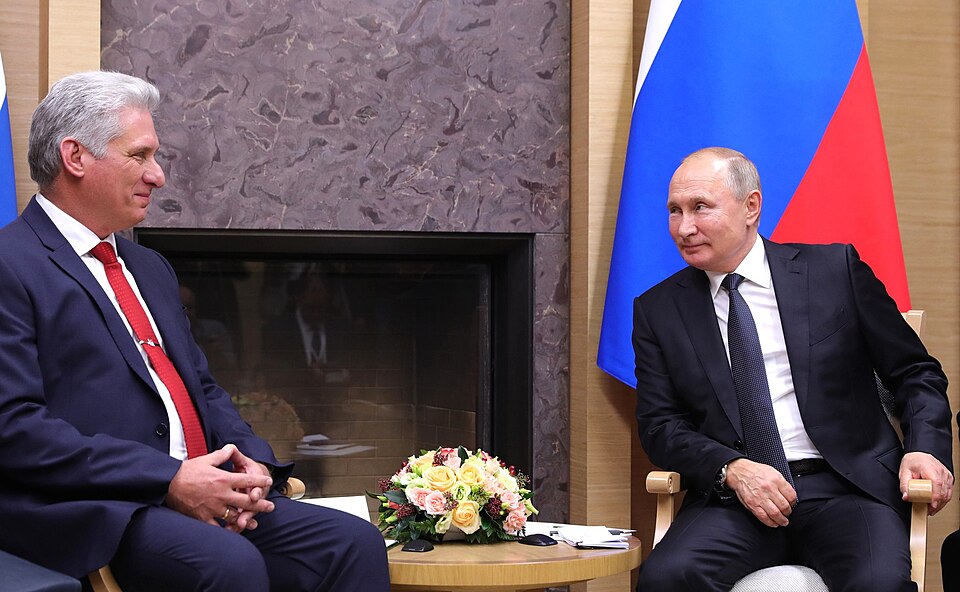
Miguel Diaz-Canel & Vladimir Putin meet in 2019. Source: Presidential Press and Information Office
In September 2022, the Deputy Minister of Energy and Mines, Tatiana Amarán Bogachova, stated that the Cuban regime had not been able to access the Russian credit of 1.2 billion euros for thermoelectric plants, as it had not managed to secure the 10% upfront payment (120 million) needed to access this credit. “The money from that loan was not used for anything. Simply put, we have not been able to resume the project. On the other hand, credits are not a gift, but a loan. There is no way for Cuba to use the money for anything other than this project,”
Amarán expressed. The “project preparation work” was carried out by Russian and Cuban companies. It took three years, from 2016 to 2019. Amarán justified this delay by claiming it was a study of great “complexity,” but the situation worsened in 2020 with the coronavirus pandemic and the deep crisis of the Cuban economy.
“It was impossible for us to secure the advance amount that would allow the Russian party to have access to the credit for the project,” said Amarán, arguing that in recent years the government prioritized other issues. … “Between 2006 and 2019, the Russian government lent Cuba $2.3 billion to finance energy, metallurgical industry, and transportation projects. However, the regime did not guarantee the maintenance of the thermoelectric plants. In February 2022, the Lower House of the Russian Parliament ratified the regulation that extended until 2027 the payment of loans granted to the Cuban regime, which has almost completely stopped repaying loans since early 2020, which “increased its debts to Russian commercial banks and exporting entities,” according to the EFE agency.
The responsibility of the kleptocratic elite in Cuba
On August 15, 2024 Tampa resident Mirtza Ocana (age 39) pled “guilty to one count of bulk cash smuggling and one count of conspiracy to commit bulk cash smuggling.” She was smuggling millions of dollars out of Cuba to the United States.
“According to court documents, Ocana returned to the United States on a flight from Cuba on February 5, 2024. Despite telling U.S. Customs and Border Protection agents that she had no cash to declare, Ocana concealed more than $31,000 in her luggage. After agents found this cash, Ocana admitted that she frequently smuggled cash into the United States from Cuba and that she had done so two to three times per month since June 2023. She also told agents that she was paid between $1,000 and $2,500 each time she smuggled cash. Agents searched Ocana and discovered an additional $71,300 in cash hidden in her clothes. In total, agents found approximately $102,700 in cash concealed both in Ocana’s clothes and in her luggage.”
“Corruption can be simple or complex. Officials fortunate enough to have control over scarce resources like fuel sell these on the black market and realize enormous profits. The preferred approach is more indirect, however. Following the outbreak of anti-regime protests in July 2021, the government allowed the establishment of private “micro, small, and medium enterprises,” theoretically as a way to open up the economy to market forces. But most if not all of the 9,000 private enterprises operating in Cuba today are owned by powerful regime figures who then funnel public works contracts to them.”
Alejandro Gil Fernández, Cuba’s Deputy Prime Minister and Minister of Economy and Planning until February 2, 2024, was detained on March 7, 2024. He has been linked to Mirtza Ocana and her “bulk cash smuggling” operation from Cuba to the United States by CubaNet. Ms. Ocana has denied the connection, but the timing and word of mouth indicate otherwise.
Money leaves Miami for Cuba and returns to Tampa for regime oligarchs, and their relatives
Nora Gámez Torres reported in the article “How Miami companies are secretly fueling the dramatic growth of Cuba’s private businesses” published in the Miami Herald on June 23, 2023 that “the money that families have sent to their relatives in Cuba for decades is now fueling an explosion of capitalism on the communist island. Businesses that facilitate that flow of cash have created a clever but complex system that is helping Cuban private entrepreneurs sidestep U.S. financial sanctions and buy abroad the supplies they need for their businesses on the island.” Now we know that millions of those dollars ended up in the pockets of high ranking Cuban officials, and funneled back into the United States through Tampa.
Cuba is in the midst of an existential crisis with a dictatorship that is a kleptocracy, has failed the Cuban populace, while at the same time destabilizing democracies in the region, sponsoring terrorism, and sending soldiers to fight in Ukraine. They have resources, but their priority is not the well being of Cubans.
Sanctions work because trading with the dictatorship, as Europe, Canada, Mexico, Venezuela, and much of the rest of the World is doing, does not translate in improvements for every day Cubans, but more resources for Havana to pursue an agenda hostile to Western democracies, and the rule of law.
On August 11, 2022 the Center for a Free Cuba published a petition for the establishment of an emergency humanitarian corridor for Cubans which called on Havana and the world’s democracies to take concrete actions. The present moment calls to reissue this petition.
“The [Cuban] government would prefer to control all relief efforts, but they don’t have the capacity to,” Nodarse Venancio of WOLA said.
We call on the Cuban dictatorship to:
- Eliminate restrictions on the distribution of humanitarian aid from international organizations and from Cubans in the diaspora to Cubans in need on the island;
- Permit visits of the International Committee of the Red Cross to Cuba’s prisons.
In addition, we urge that world democracies call on the UN Security Council to respond to the situation by sending a delegation to Cuba, and by establishing a humanitarian corridor for direct emergency assistance to needy Cubans, without regime participation.
This petition was inspired by the Christian Liberation Movement’s policy proposal “For Solidarity with Freedom of Cubans Campaign. Eleven concrete actions to isolate the Cuban totalitarian and segregationist regime.”
If you are in Washington DC next week on September 18, 2025 and want to learn more about the reality of what is happening in Cuba then you should check out the premiere at 6:30pm of the documentary Cuba’s Eternal Night at The Miracle Theatre located at 535 8th St SE. Washington DC 20003. Tickets available online.

Cuba is entirely without power following electric grid collapse
HAVANA — Cuba’s electrical grid collapsed Wednesday, leaving the entire island without power, according to the state-run power company.
“A total disconnection of the Electrical System, SEN, has occurred, which may be associated with an unexpected outage of the CTE Guiteras,” the Ministry of Energy and Mines wrote on X.
It said the causes are being investigated and the restoration process has already begun.
In the country’s capital, residents expressed concern over the blackout and not knowing how long it could take to re-establish connectivity on top of all the daily economic struggles they face, including shortages in food and medicine.
“This country can’t take much more. We just have one misfortune after another,” said a small-business owner who declined to give his name. “Let’s see how long it lasts and how it will affect us.”
Many worried about spoiling food and lack of water.
Power outages have been a chronic problem in Cuba for years, but they have worsened with the communist-run country’s economic crisis. Daily blackouts can reach up to 20 hours in some parts of the island.
There have been a series of electrical grid collapses in recent years, including in 2022 after Hurricane Ian and in October 2024 when it took days to fully restore power throughout the island.
Experts recently warned about increasing energy demand and the country’s aging and crumbling infrastructure, which requires constant maintenance.
In the past, the government has cited shortages of fuel used to fire up its plants and increasing demands for power. The government has also blamed the decades-old U.S. embargo on Cuba for making it difficult to import parts.
Cuba hit by second island-wide blackout this year as energy crisis worsens
A total blackout has hit Cuba, marking the latest in a series of outages blamed on aging infrastructure and fuel shortages at power plants
HAVANA — A total blackout hit Cuba on Wednesday, the latest in a series of outages blamed on aging infrastructure and fuel shortages at power plants.
It was the second island-wide outage this year, with three other blackouts reported late last year.
The Ministry of Energy and Mines said on social platform X the latest outage could be tied to a malfunction at one of Cuba’s biggest thermoelectric plants.
Argelio Abad, the ministry’s vice minister, said on state TV the grid shut down after an apparently erroneous message warning of overheating disconnected the thermoelectric plant. He added that officials immediately began to build a type of microsystem to deliver electricity to infrastructure that provides basic services.
The ministry said crews were working to restore power to the island of roughly 10 million people, with electricity returning to hospitals, food production plants and other high-priority businesses.
Prime Minister Manuel Marrero made an appearance at Cuba’s state-run power company and asked Cubans for their trust as he said on state TV that electricity would be restored gradually.
Some Cubans, like 65-year-old Mayté García, believed they would be without power for a couple of days.
She said she was “outside, taking in the fresh air” as she waited for electricity to return.
“If you buy something, you don’t know if you’ll be able to keep it. Many people’s food has spoiled,” García said of items in refrigerators and freezers.
Earlier this week, an outage hit Cuba’s eastern region, leaving people from Las Tunas to Guantánamo in the dark for several hours.
In February, the government suspended classes and work activities for two days due to a shortage in electricity generation.
There is a severe economic and energy supply crisis in Cuba. It has worsened in recent years due to U.S. sanctions intended to put pressure on the island to change its political model.
The sanctions have prevented the Caribbean nation from having sufficient foreign currency to buy fuel or repair its aging thermoelectric plants, many of which have been operating for more than 30 years.
Cuba hit with fifth blackout in less than a year with 10m people in the dark
Grid failure follows string of nationwide blackouts that plunged antiquated power system into near-total disarray
Emergency crews were working to restore power to 10 million people on Wednesday as Cuba suffered its fifth nationwide blackout in under a year, the energy ministry announced.
“There has been a total disconnection of the electric system,” the energy ministry and National Electric Union said early on Wednesday.
The grid failure follows a string of nationwide blackouts since late last year that plunged Cuba’s frail and antiquated power generation system into near-total disarray.
Earlier this week, an outage hit Cuba’s eastern region, leaving people from Las Tunas to Guantánamo in the dark for several hours.
In February, the government suspended classes and work activities for two days given a shortage in electricity generation.
“This is crazy for everything,” Raúl Ernesto Gutiérrez said in Havana.
Gutiérrez, who said he was visiting the capital, said that back home in the countryside, “we will have to cook with charcoal, with firewood. It’s stressful and also frustrating.”
The country has also being facing fuel, food and other shortages amid its worst economic crisis in decades. Havana state worker Danai Hernández, said she was on the way home from work which had just shut down.
“I’m going home to organize everything in the household and … now we have to wait. We don’t have any other choice,” she said, visibly upset.
Cuba’s oil-fired power plants, already obsolete and struggling to keep the lights on, reached a full crisis last year as oil imports from Venezuela, Russia and Mexico dwindled.
In October 2024, the island, which is suffering its worst economic crisis in three decades, was plunged into darkness for several days following a shutdown of the Antonio Guiteras thermoelectric power plant, the island’s biggest.
Cuba’s energy crisis has worsened in recent years due to US sanctions intended to put pressure on the island to change its political model.
The sanctions have prevented the Caribbean country from having sufficient foreign currency to buy fuel or repair its ageing thermoelectric plants, many of which have been operating for more than 30 years.
The blackouts have led to rare anti-government protests.
https://www.theguardian.com/
The Washington Times, August 26, 2025
Sanctions against Cuba work
Humanitarian corridor would aid Cubans, not the kleptocrats oppressing them
OPINION:
Cuba’s kleptocratic military junta, with billions of dollars in cash reserves, pleads penury while Cubans living in extreme poverty die because of a lack of lifesaving medications. Meanwhile, regime elites live the good life, visiting Europe and the United States.
Through its conglomerate GAESA, the Cuban dictatorship’s military has $18 billion in bank accounts, more than the foreign reserves of Costa Rica, Uruguay and Panama.
Eighty-nine percent of the Cuban population lives in extreme poverty. Although the Cuban regime claims it has no money, Cubans die, and the government uses the misery it has manufactured on the island to sell the lie. This includes a failure to purchase lifesaving drugs.
Reports that emerged in 2024 show approximately 146 patients dying daily in Cuba because of a lack of such medications. Government pharmacies have a shortage of 63 key pharmaceuticals, yet keeping these essential drugs available to Cubans would cost only $43 million annually.
Extreme poverty rates in Costa Rica, Uruguay and Panama are far lower than those recorded in Cuba. Costa Rica has an extreme poverty rate of 1.3%, Uruguay’s is 0.2% and Panama’s is 3.7%, according to Our World in Data . Uruguay is doing substantially better than the United States , which has a 1.2% rate of extreme poverty.
Extreme poverty coincides with the absence of the rule of law
What is the difference between these three Latin American countries and Cuba? The main one is the rule of law index , on which Cuba does not even register. Other Latin American countries, despite challenges, have democratic institutions, including independent judiciaries. This has been absent in Cuba since 1959.
From 1899 to 1959, Cuba had an independent supreme court. Over half a century, Cuba developed a multiparty system, competitive elections, a free press, a modern public health system and a strong labor movement. From 1902 to 1952, 17 Cuban presidents were elected in multiparty elections. This resulted in socioeconomic achievements that placed pre-1959 Cuba at the top of Latin American indexes, outperforming Castro’s Cuba.
Cuban democracy ended on March 10, 1952, when Fulgencio Batista disrupted the constitutional order. Nevertheless, the judiciary maintained independence.
Fidel Castro vowed to restore democracy and condemned Batista’s dictatorship. Instead, once in power, Castro imposed a communist dictatorship. (Before assuming power, he worked with the KGB to establish a police state.)
Rule of law versus rule by law
At the start of the Cuban revolution, Castro abolished the rule of law — a system by which laws are independently decided, equally enforced, publicly disseminated and compliant with international human rights standards — and replaced it with “rule by law,” which considers the governing authorities to be above the law, with the authority to enact and execute laws as they see fit, regardless of the impact on people’s larger liberties.
In their 2006 monograph on corruption in Cuba, Sergio Diaz-Briquetz and Jorge Perez-Lopez cited the formula “Corruption = Monopoly + Discretion – Accountability.” The communist dictatorship in Cuba has monopoly control over all aspects of life, and the military dictatorship has total discretion over how to allocate resources — and zero accountability.
Cuba’s regime is a kleptocracy
Cuba, under the Castro regime, is a kleptocracy . It is organized corruption on a grand scale, done by political leaders for their personal enrichment and maintenance of power. This is why they use front people connected to regime elites to run “private” businesses.
Havana also plunders resources of other countries , including Venezuela. It infiltrates governing structures and transnational criminal networks to enrich itself and pursue ideological objectives to export its political model.
“In many respects, Cuba can be accurately characterized as a violent criminal organization masquerading as a government,” former Defense Intelligence Agency Officer Christopher Simmons testified to Congress in 2012.
The positive role of sanctions
Loosening U.S. sanctions and providing this criminal enterprise with more resources has resulted in subjugation, first of the Nicaraguan people in 1979, during the Carter Administration , and then of the Venezuelan people in 1999, during the Clinton administration.
Hard-line policies during the Reagan-Bush years brought a democratic renaissance to Nicaragua under Violeta Chamorro in 1990, reducing Havana’s negative influence in Latin America and coinciding with a democratic wave in the region.
President Obama’s December 2014 thaw coincided with the expansion in subsequent years of the Cuban military’s control of the Cuban economy. Havana also successfully assisted Daniel Ortega’s return to power and Nicaragua’s becoming a “full-blown dictatorship” from 2014 to 2016, despite Washington maintaining a free trade agreement with Managua.
History demonstrates that sanctions work to constrain Havana’s ambitions and protect U.S. taxpayers. That’s why the Center for a Free Cuba, along with other individuals and groups, continues to argue for a humanitarian corridor to directly assist Cubans on the island while not benefiting the kleptocrats who oppress them.
John Suarez is a human rights activist and executive director of the Center for a Free Cuba and a former program officer for Latin America Programs at Freedom House.
https://www.washingtontimes.