


Fact checking Carlos Fernández de Cossío’s appearance on 60 Minutes
“Falsehood flies, and truth comes limping after it.” – Jonathan Swift The Art of Political Lying (1710).
False claim: “Cuba does not threaten the U.S. or any country.” – Carlos Fernández de Cossío, Cuba’s deputy foreign minister responding to Matt Gutman of CBS News in his November 1, 2026 appearance on 60 Minutes.
FACT: Havana threatens United States national security, props up dictatorships in Venezuela and Nicaragua, and backs Moscow imperial ambitions in Ukraine.
According to Ukrainian intelligence data — obtained from the analysis of foreign passports of mercenaries who signed contracts with the Russian army, to which they had access — this is the largest Cuban intervention abroad since the Angolan war in the mid-1970s. Between 6,000 and 7,000 Cubans are currently on the battlefield, according to the same sources, the second -largest contingent after the more than 10,000 soldiers sent by North Korea. Ukraine estimates that between 200 and 300 Cubans have died in the war.”
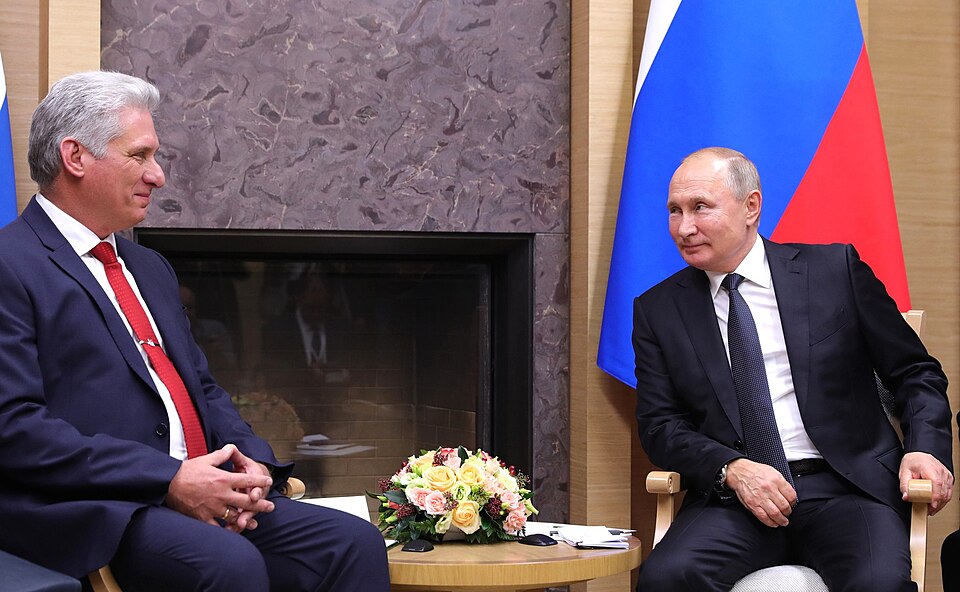
Miguel Diaz-Canel & Vladimir Putin meet in 2019. Source: Presidential Press and Information Office
On September 15, 2026, the U.S. Department of Justice unsealed charges against five members of what prosecutors call a Russian Intelligence Services (RIS) network. They are accused of conspiring to finance terrorism and, in three cases, of conspiring to commit murder for hire—including a plot to kill a Russian dissident on U.S. soil.
The defendants named by DOJ are:
- Yuri Khrameev, 63, of Russia, a former colonel in Russian intelligence services, also known as “Colonel Yuri.”
- Kirill Khrameev, 27, of Russia, an FSB officer and son of Yuri Khrameev.
- Oemis Romagoza Durruthy, 35, a Cuban national described as an influential figure in the Cuban diaspora in Russia.
- Yaidel Delgado Suarez, 35, of Cuba, also known as “Viking,” described as a prolific recruiter.
- Angel Eduardo Castro, 22, of Venezuela, who helped recruit people inside the United States.
Assistant Attorney General for National Security John A. Eisenberg said the defendants “allegedly operated as a global assassination network that reached into the United States, attempting to recruit U.S. citizens and foreigners to carry out killings at the behest of the Kremlin.”
The indictment alleges the network has operated since at least 2024. Recruits in the United States were paid for surveillance and offered as much as $40,000 to “eliminate” or “disappear” a U.S. resident, and $25,000 for a killing in Lithuania or for sabotage such as arson against warehouses or electrical substations. Prosecutors say the targets included Russian dissidents and civilian and military infrastructure in European countries perceived as supporting Ukraine. All five defendants remain at large.
Orders to carry out sabotage such as arson targeting warehouses echoes orders given to the Castro regime’s WASP network that was dismantled by the FBI in 1998.
The DW investigation that preceded the indictment
One day before the charges were unsealed, Deutsche Welle broadcast the investigation Russia’s secret network of “disposable agents” in Europe. The report, by Julett Pineda, Mathias Bölinger, and Anna Chaika, traced a 2024 wave of arson and sabotage in Poland, the Czech Republic, Romania, and Lithuania to Russian services using cheap, deniable recruits—migrants, job-seekers, and Spanish-speaking Latin Americans—rather than formal intelligence officers.
DW identified the recruiter behind the aliases “Adrian” and “Dios” as Oemis Romagoza Durruthy, born in Camagüey, Cuba. For years he has lived in Petrozavodsk, in northern Russia, teaching salsa, bachata, and kizomba at a studio called Made in Cuba. He married a Russian citizen in 2022 and later obtained Russian citizenship. Online, according to DW and partner outlets, he posted job offers in Facebook and Telegram groups for Cubans in Russia and other Latin Americans, offering about $1,500 plus bonuses per operation and seeking people with military or logistics experience. Lithuanian prosecutors have publicly tied the Lithuania plot to Russia’s GRU and placed Romagoza on an international wanted list. At least nine alleged recruits have been arrested; some are already serving prison terms.
DW’s September 16 report on the U.S. charges notes that DOJ went further than the European sabotage cases: Romagoza is also accused of helping obtain images of a dissident’s residence in the United States, material later used for surveillance on American soil. Delgado Suarez, the second Cuban, is accused of trying to recruit people in the United States and of referring to “people in Mexico” as an option for killings. Castro, the Venezuelan, is accused of helping that U.S. recruitment.
This is not about two isolated émigrés who happened to take dirty money. It is a about a Cuban–Venezuelan recruitment node inside a Russian intelligence operation: Spanish-speaking intermediaries, Latin American “disposable agents,” European sabotage, and an alleged murder plot that reached the United States.
What this indictment makes unavoidable
First, Havana is not a bystander in Moscow’s war against Ukraine or in Russia’s campaign of transnational repression. Two of the five charged defendants are Cuban. One is Venezuelan. The recruitment pool described by both DOJ and DW is Spanish-speaking and Latin American.
Second, the threat is not confined to Europe. Prosecutors say the same network tried to hire people in the United States to surveil and kill. That is the definition of a foreign intelligence service treating American soil as an operational theater.
Third, “people-to-people” and diaspora channels are not automatically benign. Romagoza is described as influential in the Cuban community in Russia. Delgado Suarez allegedly recruited from inside the United States. Any serious Cuba policy has to treat Havana’s overseas communities, intelligence services, and allied networks in Venezuela as a single security problem, not as a cultural exchange.
Fourth, the Tricontinental anniversary events Havana staged in January 2026 were not harmless historical pageantry. They were a reminder that the regime still claims the inheritance of 1966: an international of violence justified as solidarity. The September 2026 charges show that inheritance in operational form.
The unsealed indictment and the DW investigation do not ask the public to take that argument on faith. They put Cuban names on a Russian terrorism and murder-for-hire case.
The defendants are fugitives. The network, if the charges are proven, will not retire because five men were named. Why did 60 Minutes not raise questions about this with Cuba’s deputy foreign minister?