


FACT CHECK
On Saturday, September 12, 1998, the FBI dismantled the largest Cuban spy ring ever discovered in the United States. Ten people were charged with being Cuban spies. The regime in Cuba has spent 27 years attempting to airbrush this past.

Ten, not five, Cuban spies captured by FBI on 9/12/98
The ten members of the WASP network captured were: GERARDO HERNANDEZ, 31 (alias Manuel Viramontes), the spymaster; FERNANDO GONZALEZ, 33 (alias Ruben Campa), and RAMON LABANINO, 30 (alias Luis Medina), another Cuban intelligence officer. The remaining seven were mid-level or junior agents who passed their reports to one of these three senior agents. Included were ANTONIO GUERRERO, 39, who observed aircraft landings at the Boca Chica Naval Air Station from his job as a sheet-metal worker there; ALEJANDRO ALONSO, 39, a boat pilot; and RENE GONZALEZ, 42, a skilled aircraft pilot and the only Cuban national among these seven. Both joined the Democracy Movement to report on its nonviolent activities against the Castro regime. Two married couples, all American citizens, also worked in the spy network: NILO and LINDA HERNANDEZ, ages 44 and 41 respectively, and JOSEPH and AMARYLIS SANTOS, both 39.

Cuban spy Juan Pablo Roque escaped.
JUAN PABLO ROQUE, an eleventh spy also charged and linked to the 1996 Brothers to the Rescue shoot down, had already fled to Cuba, a day before Cuban MiGs launched missiles destroying two planes, and killing four. Three others identified as John Does were also charged. He was also an FBI informant who gave false information to federal agents.
Five defendants, Alejandro Alonzo, Nilo Hernandez and Linda Hernandez, Joseph Santos and Amarylis Santos, accepted plea bargains and cooperated with prosecutors. These five Cuban spies provided information about the other five.
The other five spies eventually went on trial. The trial revealed that the Cuban spy ring was engaged in both espionage, terrorism, and facilitated the extrajudicial killing of three U.S. citizens and a U.S. resident.

The Wasp Network engaged in espionage: infiltrated two non-violent exile groups, provided information that led to the extrajudicial killings of Armando Alejandre, Carlos Costa, Mario de la Peña and Pablo Morales on February 24, 1996, targeted U.S. military facilities, planned to smuggle arms and explosives into the United States, and carried out other active measures to sow division, shape public opinion, and meddle in U.S. elections.
The Cuban spy network gathered personal information on American military personnel, “compiling the names, home addresses, and medical files of the top officers of the United States Southern Command as well as hundreds of officers stationed at Boca Chica Naval Station in Key West.”
The spies had received orders from Havana to burn down an airport hangar, sabotage planes, first terrorize with warnings that he was “nearing execution,” and then send a mail bomb to murder a CIA operative identified as Jesus Cruza Flor who lived in Bal Harbour.
The five who refused to make a deal.
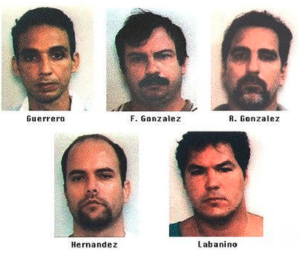
The five who refused to make a deal.
On June 8, 2001, the five Wasp defendants who had not entered into plea bargains were found guilty on all counts. In December 2001, three of the spies were sentenced to life in prison for conspiracy to commit espionage. Gerardo Hernandez and Ramon Labanino, both Cuban nationals, and Antonio Guerrero, a U.S. citizen, were sentenced to life in prison. Fernando Gonzalez and Rene Gonzalez, both Cuban nationals, were sentenced to 19 and 10 years in prison for conspiracy and operating as unregistered agents of a foreign power, respectively.
Five Cuban spies who made a deal.
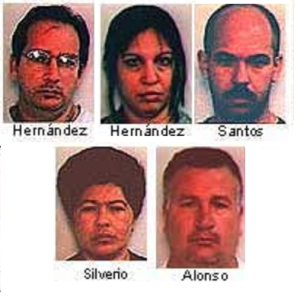
Five Cuban spies who made a deal.
The five who pleaded guilty to one count of acting as unregistered agents of a foreign power and cooperated received lesser sentences: Alejandro Alonso, Nilo Hernandez, and Linda Hernandez were sentenced to seven years in prison, Joseph Santos was sentenced to four years, and Amarylis Santos was sentenced to three and a half years.
Cuban spy convicted of murder conspiracy freed by President Obama in 2014
Gerardo Hernandez, the head of the network was convicted of murder conspiracy and espionage and condemned to a double life sentence. President Obama commuted Hernandez’s double life sentence on December 17, 2014, as part of the concessions made in the effort to normalize relations between Cuba and the United States.
Gerardo Hernández was promoted to Deputy National Coordinator of the Committees for the Defense of the Revolution (CDR) in April 2020, tasked with monitoring neighborhood committees to spy on all Cubans on the island. He was also appointed to the Castro dictatorship’s Council of State, the 31-member body that oversees day-to-day life on the island, on December 17, 2020.

Cuban spy Gerardo Hernandez and Watam Jamil Alabed of the Popular Front for the Liberation of Palestine
This picture of Gerardo Hernandez Nordelo and Watam Jamil Alabed taken in May 2022. Although Watam Jamil Alabed is portrayed by Havana as a young Palestinian doctor who studied in Cuba, his own statement made on May 2, 2022 in Havana at the the “International Meeting of Solidarity with Cuba” offers a better understanding of the “education” the Cuban dictatorship is providing youth who study in Cuba.
“Thanks to Cuba we learn to not just be doctors; but to give this doctor a surname to follow Che’s example in his revolutionary, warrior and internationalist character. … Today we reiterate our position with just causes, with Cuba, with Venezuela, with Nicaragua, Sahara, our right to resistance with all permitted methods and by all means and that we learned from the commander in chief Fidel Castro, guerrilla struggle and armed resistance will continue until the Zionist prisons are emptied of Palestinian prisoners, and all of Palestine down to the last grain of sand is liberated to have a democratic and socialist Palestine.”
This is not an over statement, Havana under the Castro regime, has trained and provided logistical support to Palestinian guerrillas and terrorists beginning in the early 1960s, and continues to do so to the present day. The Cuban dictatorship has been supporting Islamist terrorists and spreading anti-Semitic tropes for decades.
Havana is also supporting Vladimir Putin’s war in Ukraine. It is not a coincidence that Gerardo Hernández was in Moscow on May 31, 2023, leaving a wreath on a monument to Fidel Castro.

Providing context
The 2009 book Betrayal: Clinton, Castro & The Cuban Five by Matt Lawrence, and Thomas Van Hare provides a compendium of the evidence. It exposes the facts about what happened and who knew prior to the murder of three Americans and one legal resident. All were volunteers out to save the lives of fleeing refugees. Below is a video introduction to the book by Matt Lawrence, one of the authors. Lawrence had volunteered his time, and flown search and rescue for Brothers to the Rescue.
The Brothers to the Rescue shoot down on February 24, 1996, and the influence operation conducted by Ana Belen Montes to direct blame away from the Castro regime, and onto the victims, drew the attention of investigators, and in September 2001 led to the arrest of this spy for Havana working in a sensitive position at the Defense Intelligence Agency (DIA) in the Pentagon. This is also explored in the book by Lawrence and Van Hare.
State security murders fleeing Cubans
On July 13, 2022, Jorge A. Garcia, a Cuban writer and journalist who lost 14 family members in the massacre, gave an account of what transpired that early morning in 1994.
“It was not an accident as the spokesmen of the dictatorship usually claim on this date. I still have very fresh in my mind the testimony of the survivors and the results of my investigations about what happened that dark night of July 13, 1994, at 3:50 in the morning, seven miles from the Havana seawall: Under the command of Division General Senén Casas Regueiro, the regime carried out a macabre punishment with the support of three vessels Polargo 2, 3, and 5 (mostly manned by undercover soldiers). Using pressurized water jets and heavy rolls, they sank the tugboat 13 de Marzo with 68 people on board. Despite the plea of the victims, many without knowing how to swim, thrust into the sea and surrounded by sharks, the murderous ships left the scene without providing help. The genocide left a toll of 37 dead (10 children included) and 31 survivors. The bodies were never returned to their families to give them a Christian burial.“
In the January 20, 1998, Nightline special “Crossing the Divide,” Jorge was interviewed about how he learned the news of the full extent of his loss. “When I asked my daughter, ‘What about Juan Mario?’ ‘Papa, he’s lost.’ ‘And Joel?’ ‘Papa, he’s lost.’ ‘And Ernesto?’ ‘Papa, he’s lost.’ And then we knew that other members of the family were all lost, 14 in all.”
His daughter, María Victoria Garcia, was one of three family members who survived the slaughter. Among the dead were her brother Joel García Suárez (24), husband Ernesto Alfonso Loureiro (25), and son Juan Mario Gutiérrez García (10).

María Victoria refused to support the false regime narrative. “I told the colonel that it had not been an accident, that they sank us,” she said in an interview with Voces de Cuba nine years ago, recalling her immediate reaction. Her father, Jorge Garcia, revealed that when she spoke out, the young widow had been the subject of assassination attempts. “They tried on several occasions to kill my daughter, because she was the first to speak out and contradict the regime’s official narrative.“
Father and daughter fled Cuba out of the well-grounded fear that after the broadcast of their interviews on Nightline, they would either be jailed or killed. Jorge A. Garcia published in 2001 an extensive investigation in Spanish on “The Sinking of the 13 De Marzo Tugboat.” Both passed away in 2024 due to natural causes, after enduring years of post-traumatic stress disorder.
The Inter-American Commission on Human Rights on October 16, 1996 published a report on the merits about the tugboat massacre that is available online.
State security murders Cuban dissident leaders

Rosa María Payá spoke at the 8th Geneva Summit for Human Rights and Democracy on February 23, 2016, about the July 22, 2012, incident involving her father, Oswaldo Payá, and friend Harold Cepero.
“On July 22, 2012, my father was extrajudicially executed by agents of the political police, together with my dear friend Harold Cepero, staging a car crash that never took place, in a location of Cuba that remains to be determined. Not satisfied with this double crime, my family was threatened with death… In the summer of 2015, a special report was released by the Human Rights Foundation, where all evidence indicates that this was a crime against humanity, with the involvement of Cuban authorities. We’ll never give up on justice, because there can be no reconciliation without the recognition of the whole truth. A nation that pretends to forget the violence against its innocent people will remain a captive nation. And it will be a nation condemned to suffer such violence over and over again.“
On June 12, 2023 the Inter-American Commission on Human Rights published their report on the merits that found Cuban government state security agents responsible for the deaths of the two pro-democracy leaders and Christian Liberation Movement leaders.
State terrorism
On May 17, 2012 the Subcommittee on the Western Hemisphere in the U.S. Congress’s Committee on Foreign Affairs held a hearing on “Cuba’s Global Network of Terrorism, Intelligence, and Warfare.” Among the experts who spoke at the hearing was Mr. Christopher Simmons, founding editor of Cuba Confidential, an online blog and source for news on Cuban espionage worldwide. He is an international authority on the Cuban Intelligence Service and retired from the Defense Intelligence Agency with over 23 years of experience as a counterintelligence officer, and played an important role in the capture of Ana Belen Montes.
Simmons ended his presentation outlining and summarizing the high profile act of state terrorism that killed four Cuban Americans in an operation conducted on orders from highest levels of the Castro regime.
“Last, but not least, of the highlighted issues, I’d like to address Operation Scorpion which was addressed earlier as a shoot down of Brothers to the Rescue. While this mission on February 24, 1996 predates the other information I discussed, it is important because this act of terrorism involves highest levels of the Castro regime. On February 24, 1996, Cuban MiGs shot down two U.S. search and rescue aircraft in international waters. Code named Operation Scorpion, it was led by General Eduardo Delgado Rodriguez, the current head of Cuban intelligence. It was personally approved by Fidel Castro and supported by Raul Castro, the current President of Cuba. Four Americans were murdered in this act of terrorism.”
The case of the Cuban WASP network and its involvement in the 1996 Brothers to the Rescue shoot down conspiracy, and plotting to terrorize and murder a retired U.S. intelligence agent underscored once again the terrorist nature of the Cuban dictatorship on the international scene.
Origins of the security apparatus
“Che’s obsession with collectivist control led him to collaborate on the formation of the security apparatus that was set up to subjugate six and a half million Cubans. In early 1959, a series of secret meetings took place in Tarará, near Havana, at the mansion to which Che temporarily withdrew to recover from an illness. That is where the top leaders, including Castro, designed the Cuban police state. Ramiro Valdés, Che’s subordinate during the guerrilla war, was put in charge of G-2, a body modeled on the Cheka. Angel Ciutah, a veteran of the Spanish Civil War sent by the Soviets who had been very close to Ramón Mercader, Trotsky’s assassin, and later befriended Che, played a key role in organizing the system, together with Luis Alberto Lavandeira, who had served the boss at La Cabaña.”

Afro-Cuban scholar Carlos Moore, who “met” Ramiro Valdés in 1962 offered the following observation of Commander Valdes in 2010:
Ramiro Valdés was an inflexible, totalitarian and brutal person. He was the most feared man in Cuba. The repressive policies of the regime were crafted by him. Valdés struck fear into the hearts of Cubans (even revolutionary ones). Today, he apparently continues to be the same dogmatic, sectarian and brutal person he was at the height of his power, but he is no longer the powerful figure that he used to be.
Fulgencio Batista fled Cuba on January 1, 1959, taking all by surprise, it took Fidel Castro seven days to arrive in Havana on January 8th.
Washington recognized and backed the Castro brothers.
On January 7, 1959 the United States recognized the revolutionary regime ushered in by the Castro brothers. [ In comparison it had taken the United States 17 days to recognize the government of Fulgencio Batista following his March 10, 1952 coup. The United States had not been consulted ahead of time about Batista’s coup and Washington offered to back the ousted democratic president Carlos Prio, but the last democratically elected president of Cuba at the time initially refused to resist the coup.]
Ambassador Earl E. T. Smith was replaced as U.S. Ambassador to Cuba by Philip W. Bonsal in January 1959 who counseled Washington for the first year of the Castro regime to pursue a policy of patience and forbearance with the consolidating communist dictatorship.
Vice President Richard Nixon met with Fidel Castro for three hours on April 19, 1959 at the Vice President’s formal office in the U.S. Capitol.
What was Havana doing during this honeymoon?
- Fidel Castro visits Caracas on January 23, 1959 and meets with Venezuelan President Romulo Betancourt, a social democrat, “to enlist cooperation and financial backing for ‘the master plan against the gringos.’”
- On March 3, 1959 the Castro regime expropriates properties belonging to the International Telephone and Telegraph Company, and took over its affiliate, the Cuban Telephone Company.
- On March 26, 1959 the secret police apparatus was established in Cuba.
- Havana beginning in 1959 sent armed expeditions to overthrow governments in Latin America.
- On April 18, 1959 a group of Cuban-backed Panamanian exiles and revolutionaries, together with Cubans, aiming to overthrow the government of Panama sailed from Cuba to Panama. The invasion failed due to lack of support from local Panamanians, and resistance from the authorities.
- On May 17, 1959 the government expropriated farm lands over 1,000 acres and banned land ownership by foreigners.
-
On June 14, 1959, Castro backed a group of Cuban and Dominican exiles who launched an expedition from Cuba to the Dominican Republic to overthrow the government there. This operation, often referred to as the “Luperón Invasion” (named after the town where the rebels landed), involved around 200 men, including Cuban revolutionaries and Dominican dissidents. Battle broke out, but the Dominican government stopped the invasion with military force.
- Havana began providing funds to subversives in Columbia in 1960.
- On February 6, 1960 talks began publicly between the U.S.S.R and Fidel Castro. The Soviet Union agreed to buy five million tons of sugar over five years. They also agreed to support Cuba with oil, grain, and credit.
- On February 13, 1960 the Cuban-Soviet Commercial Agreement was signed. Talks of military assistance begin.
- On February 20, 1960: Cuba signed a trade and payments agreement with East Germany.
The Ministry of State Security of the German Democratic Republic (MGB GDR) founded on February 8, 1950 is known as the Stasi. The German Democratic Republic is better known as East Germany.
- In the Summer of 1960, Raul Castro visited Czechoslovakia and met with Jan Sejna, a high-level Czech official. They worked together to establish drug-trafficking networks throughout Latin America and to infiltrate those already in existence. The United States was the main target. Jan Sejna was the secretary of the Czech Defense Council and assisted in the planning of this activity and monitored its implementation.” The idea was to increase the capacity of narcotics networks to flood the U.S., and poison its soft underbelly.
- On July 6, 1960 the Castro regime passed a nationalization law authorizing nationalization of U.S.- owned property through expropriation. Texaco, Esso, and Shell oil refineries were taken.
-
On July 18, 1960 Khrushchev met Raul Castro, discussed potential military protection.
- On August 29, 1960 the Cuban government diplomatically recognized North Korea.
- On September 28, 1960 the Cuban government diplomatically recognized the People’s Republic of China.
First U.S. economic sanctions imposed on Cuba.
The Eisenhower State Department in response to the above actions publicly imposed the first trade embargo on Cuba on October 19, 1960, and it “covered all U.S. exports to Cuba except for medicine and some foods.” In October 1960, Ambassador Bonsal was ordered home from Cuba for “indefinite consultation,” and never returned. It took 21 months, and 18 days of hostile actions by Havana for Washington to respond with sanctions.
- On November 19, 1960 Ernesto “Che” Guevara headed a Cuban delegation to Beijing that met with Mao Zedong, Zhou Enlai, and other high ranking Chinese officials and discussed revolutionary objectives in Latin America. This included the prospects for communist revolution in the Western Hemisphere.
- On January 3, 1961 Fidel Castro communicated with the Eisenhower Administration demanding the expulsion of 67 U.S. diplomats, within 48 hours, reducing their number to 11, the same number at the Cuban embassy in Washington DC. The Americans had over 50,000 visa applications to process when the ultimatum was delivered. Tens of thousands of Cubans were lined up outside of the U.S. embassy in Havana seeking visas to flee the new dictatorship.
- On January 3, 1961 at 8:30 p.m. EST President Eisenhower issued a statement stating: “There is a limit to what the United States in self respect can endure. That limit has now been reached,” and severed diplomatic relations with Cuba.
This blog has posted entries on the Bay of Pigs, the Cuban Missile Crisis, the assassination of John F. Kennedy, and the 1966 Tricontinental meeting in Havana that spawned terrorists networks, sponsored by Havana, around the world.
Spies for Cuba a danger to U.S. national security as American secrets are sold around the world
By Cecilia Vega
This is an updated version of a story first published on May 19, 2023. The original video can be viewed here.
In April, a career American ambassador pleaded guilty to spying for the intelligence service of Cuba. Victor Manuel Rocha served his country in positions that required the highest levels of security clearance. For 40 years, he was a covert agent. Before Ambassador Rocha was exposed, there was another prolific Cuban spy named Ana Montes, a Pentagon official, who was the lead analyst on Cuba policy. She spied for 17 years. But, Cuban spy craft isn’t just a relic of the Cold War. It’s a real and present danger to U.S. national security. As we first reported this spring, it turns out, Cuba’s main export isn’t cigars or rum, it’s American secrets-which they barter and sell to America’s enemies around the world.
It was 1999 and then first lady Hillary Clinton danced with the president of Argentina at a state dinner. President Clinton also danced the tango across the White House ballroom.
There in front wearing glasses and the airs of an aristocrat… stood Victor Manuel Rocha. He was the number two diplomat at the U.S. embassy in Buenos Aires with an impeccable reputation as a senior statesman on Latin America. He served on the National Security Council and became the ambassador to Bolivia—seen here alongside that country’s president—all that time while having the highest top secret security clearance, with access to the most sensitive U.S. intelligence.
But last December, Attorney General Merrick Garland announced Rocha’s arrest. He was charged with spying for Cuba for his entire career.
[ Full article ]
Cuba will attempt to influence 2024 elections in Florida, U.S. intelligence warns
By Michael Wilner and Nora Gámez Torres
The U.S. intelligence community believes the Cuban government will attempt to influence U.S. elections in 2024, possibly deploying targeted campaigns to affect state and local races in Florida, officials with the Office of Director of National Intelligence said.
The assessment comes after the director’s office assessed last year that Havana attempted to affect midterm elections in Florida in 2022.
“We’ve seen interest in down ballot races,” one of the intelligence officials said. “On Cuba, we very much expect that the same kind of activity will occur.”
The intelligence community had found that, in 2022, Cuba conducted influence operations in the United States “aimed at denigrating specific U.S. candidates in Florida.”
[ Full article ]
https://www.miamiherald.com/news/nation-world/world/americas/cuba/article289243045.html
Miami Herald, May 13, 2024
History of Cuban spying and the harm done to the U.S.
Victor Manuel Rocha is the latest Cuban spy sentenced for his crimes, but he’s far from the first captured in the U.S. Since the early 1960s, the Cuban government has recruited dozens of agents or double agents. In all cases, the damage done to the U.S. and its security has been hard to gauge.
In Rocha’s case, he spent over 40 years spying for communist Cuba at the U.S. State Department, holding important postings in Latin America and in the National Security Council.
Later, he worked as a private consultant for the U.S. Southern Command in Doral, which oversees Cuba. The Associated Press reports that “Federal authorities have been conducting a confidential damage assessment that could take years to complete,” when discovered, much of it will remain classified.
Rocha was sentenced to 15 years in federal prison in April and fined $500,000.
Other spies have stolen U.S. intelligence that may have gotten Americans killed and engaged in influence operations to downplay Havana’s threat to the U.S.
Spying for Havana were Ana Belen Montes, who spent 17 years at the Pentagon in the Defense Intelligence Agency; Walter Kendall Myers, a high ranking analyst at the State Department who spent 30 years spying with his wife Gwendolyn; and Marta Rita Velazquez, a legal officer at the Agency for International Development, who recruited Montes.
Carlos Alvarez, a psychology professor at Florida International University, spent nearly 30 years with his wife, Elsa, spying on their community, and organizing trips for students to Cuba. Philip Agee, who worked at the Central Intelligence Agency, defected to Cuba in 1973 and outed 250 CIA officers and agents.
In addition, Castro’s spies, who pass themselves off as diplomats, operate in Havana’s embassy in Washington and at Cuba’s United Nations Mission in New York City. The Cuban dictatorship also sends illegal agents to spy and conduct active measures in America.
Havana’s WASP spy network infiltrated the United States to gather information on military installations and personnel, sow division among Cuban exiles, locate places to store weapons and explosives and terrorize then assassinate a CIA agent living in Florida with a mail bomb. They helped kill four in the Feb. 24, 1996 Brothers to the Rescue shootdown, and the network’s head Gerardo Hernandez was convicted of murder conspiracy.
These practices began in 1959. In 1961, the Soviet Defense Council gave Czechoslovakia orders to use Cuban intelligence to infiltrate existing drug operations in the U.S. and Latin America and to lay the groundwork for “recruiting” these independent activities. The former high-ranking Czech official Jan Sejna gave a detailed account of his meetings with Raul Castro, which he had on average four times a year between 1961 and 1968, the same year Sejna defected to the U.S..
After the State Department determined in January 1982 that Havana had armed the M-19 terrorist group in exchange for drugs smuggling to the U.S., Cuba was added to the state terror sponsors list on March 1, 1982
Four high-ranking Cuban officials were indicted by a U.S. grand jury for narcotics smuggling on November 5, 1982.
- Rene Rodriguez-Cruz, Cuban Communist Party Central Committee member and president of the Cuban Institute of Friendship With The Peoples.
- Aldo Santamaria-Cuadrado, a vice admiral in the Cuban navy and Cuban Communist Party Central Committee member.
- Fernando Ravelo-Renedo, Cuban ambassador to Colombia..
- Gonzalo Bassols-Suarez, former minister-counsel of the Cuban embassy in Bogota and Cuban Communist Party member.
Montes was recruited by Cuban intelligence agents in New York City in December 1984, and on Sept. 30, 1985 she reported to work at the Defense Intelligence Agency (DIA) in the Pentagon.
Former Army counterintelligence special agent Reg Brown also came to the DIA in 1985. Chris Simmons, a career Counterintelligence Officer, in his 2023 book, Castro’s Nemesis describes how Brown conducted an assessment that revealed the “Castro regime still trafficked drugs” and that this involved the “organized and sustained involvement by many of Fidel’s highest ranking officials.”
A Cuban spy in the DIA warned Havana that their role in flooding the U.S. with cocaine would be discovered.
This was not the end of the Havana Cartel. With the rise of Hugo Chavez in Venezuela in 1999, Havana played a major role in the formation of the Soles Cartel, and the dramatic increase in cocaine entering the U.S. over the next 25 years.
There is no doubt. Rocha and other Cuban spies like him harm the U.S. government and tens of thousands of innocents.
John Suarez is Executive Director for Center for a Free Cuba.
Miami Herald, October 21, 2022
Newly revealed documents show early influence of Soviet Union on Castro’s revolution
By Nora Gámez Torres October 21, 2022
Long before Fidel Castro proclaimed the “socialist character” of his revolution on April 1961, the new regime was already on the path to communism and was “discreetly” placing sympathizers in key positions in government, Castro’s younger brother Raúl told Soviet leaders, according to a rare document obtained by the Washington-based National Security Archive. The recently declassified document from the State Archive of the Russian Federation, an official record of a conversation in Moscow between Cuba’s defense minister, Raúl Castro, and the Soviet premier at the time, Nikita Khrushchev, on July 18, 1960, provides previously unknown details of the crucial moment the two countries sealed an alliance that would push the world to the brink of nuclear war just two years later during the Cuban Missile crisis.
[ Full article ]
https://www.miamiherald.com/news/nation-world/world/americas/cuba/article267467793.html
The New York Times, March 13, 1998
Manuel Pineiro, Spymaster For Castro, Is Dead at 63
Manuel Pineiro, the ruthless but urbane spymaster who for more than 30 years led Cuba’s intelligence apparatus and directed its efforts to export revolution to the third world, died in a car crash in Havana early today, the Cuban state news agency Prensa Latina reported. He was 63.
Known as ”Barba Roja,” or ”Red Beard,” because of his chief identifying feature as a young man, Mr. Pineiro served as Cuba’s main liaison and dispenser of weapons and cash to grateful and admiring Latin American guerrilla groups. His adversaries at the Central Intelligence Agency, however, regarded him as a cunning and dangerous foe, the Cuban equivalent of the East German espionage wizard Markus Wolf.
”This is the man who knew all the secrets of the Cuban Revolution and was on a first-name basis with two generations of Latin American revolutionaries and leaders,” Jon Lee Anderson, the author of ”Che Guevara: A Revolutionary Life,” said in a telephone interview from Spain today. ”In conversing with him, you were very much aware that he was intimate with and an important part of the whole nether world of the cold war.”
In his book ”Utopia Unarmed: The Latin American Left after the Cold War,” the Mexican scholar Jorge Castaneda describes Mr. Pineiro as the one figure who ”more than any other personified the armed revolutionary struggle” in the Western Hemisphere. ”From the very beginning of the Cuban Revolution, this man played a key role in building what became one of the most successful security agencies ever constructed,” Mr. Castaneda wrote.
From 1961 until 1974, as Deputy Minister of the Interior, Mr. Pineiro was in charge of the state security apparatus that both protected Fidel Castro and other Cuban leaders from assassination attempts and infiltrated spies into the Cuban exile movement here. In that post, he also supervised the establishment of the internal security organs that monitored and severely punished any sign of domestic opposition to Mr. Castro’s rule.
By the mid-1970’s, Mr. Pineiro had been placed in charge of the innocuously named Americas division of the international relations department of the Central Committee of the Cuban Communist Party. Unofficially known as the ”Ministry of Revolution,” that entity supplied arms, money, intelligence, guidance and a rear base to a variety of leftist guerrilla movements in Latin America that wanted to duplicate the Cuban model.
When the Sandinista National Liberation Front overthrew the dictatorship of Anastasio Somoza in Nicaragua in 1979, its leaders privately described as indispensable the role played by Mr. Pineiro, who spent several months in Managua as an adviser to the new Government. A period of intense activity followed into the early 1980’s, with Mr. Pineiro helping to organize and direct revolutionary movements in El Salvador, Guatemala, Colombia and Grenada.
In recent years, with a cash-strapped Cuba intent on improving relations with the rest of Latin America in the wake of the collapse of the Soviet bloc, Mr. Pineiro had become somewhat superfluous, and his activities diminished. Officially retired, he became a fixture on the Havana diplomatic party circuit, the luxuriant beard that gave him his nickname now a snowy white.
Diplomats in Havana said today that Mr. Pineiro had attended a reception at the Mexican Embassy on Wednesday and apparently lost control of the car he was driving as he returned home. Though both Cuban and foreign officials today cited unconfirmed accounts that he had suffered a heart attack, the brief official Prensa Latina report announcing his death offered no details, saying merely that he had perished ”as a result of an automobile accident.”
Manuel Pineiro Losada was born on May 14, 1934, the son of the Bacardi rum representative in the province of Matanzas. He had a privileged upbringing, and when it came time for him to enroll in college, his father sent him to study business at Columbia University in New York, where he met and married his first wife, an American ballet dancer named Lorna Burdsall.
But after his return to Cuba, Mr. Pineiro joined Mr. Castro’s 26th of July Movement, smuggling arms and supervising urban bomb attacks before he took to the Sierra Maestra to become a guerrilla fighter. He was quickly assigned to the staff of Raul Castro, Mr. Castro’s brother, on the eastern front and, according to Mr. Castaneda, ”began building the Cuban intelligence and security apparatus even before the revolution had triumphed.”
The low point of Mr. Pineiro’s career, most intelligence experts agree, came in 1967, when Che Guevara was captured and killed in Bolivia while leading a revolutionary insurgency that Mr. Pineiro was supervising and supplying from Havana. As recently as October, as Cuba was commemorating the 30th anniversary of Mr. Guevara’s death, Mr. Pineiro was still defending his decision not to send a rescue team to extract the Argentine-born guerrilla hero, with whom he had often disagreed on ideological and strategic questions.
In recent years, Mr. Pineiro continued to cultivate his contacts with his former proteges in the Cuban intelligence and security apparatus and with foreign diplomats, intellectuals and journalists, many of whom remain unconvinced by his assurances that he was then out of the intelligence business. Those who met him in Havana found him to be elegant and cultured, a connoisseur of food, wine, the opposite sex, conversation and literature.
”He was one of the last of the old hard-liners, a true-blue, unrepentant revolutionary and Fidelista,” Mr. Anderson said. ”But as a person, he was extraordinarily perceptive, a great raconteur, a roue almost, very personable and blunt, with an endearingly roguish way about him.”
Mr. Pineiro is survived by his wife, the Chilean journalist, writer and Marxist theoretician Marta Harnecker, and a daughter. He was buried this afternoon at Colon Cemetery in Havana with President Castro in attendance and with the full official honors due him as a Commander of the Revolution.
https://www.nytimes.com/1998/03/13/world/manuel-pineiro-spymaster-for-castro-is-dead-at-63.html